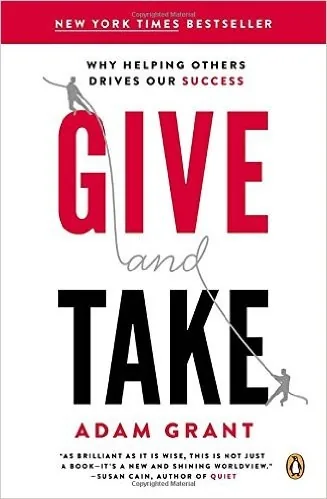
Give and Take
Why helping others drives our success. A Wharton professor's evidence that reciprocity style — giver, taker, matcher — shapes who rises, and how.
Why This Book Matters to Me
Grant gave me the vocabulary for something I had been doing by instinct: generosity, practiced wisely, is not a cost but a strategy. Giver logic explains how a student with no capital built networks that became ventures — TawjihYou, Vanguard-Community, Maalam — because giving first creates obligations of goodwill that compound.
Just as important, the book warned me about my own default. Selfless giving burns out; otherish giving — generous in approach, clear about boundaries — is the version that survives. That distinction preserved my energy across six ventures.
Key Ideas Applied
Diagnose Reciprocity Styles
Knowing whether someone is a giver, taker or matcher changes how I invest in the relationship — and protects teams from extractors.
Give in High-Impact, Low-Cost Ways
Five minutes of introduction, feedback or mentoring can be worth hours elsewhere; I systematized small acts of value instead of grand sacrifices.
Protect the Core — Otherishness
Generosity with boundaries: I give freely where my cost is low and the other's gain is high, and I guard the hours my mission depends on.
Ripple Effects
A giver culture raises the whole team's behavior; modeling generosity in my teams made cooperation the default, not the exception.
Favorite Quotes
On Styles"Takers like to get more than they give; matchers trade evenly; givers give more than they take — and each style shapes the network around it."
On Success"The best givers succeed not at the expense of others but in a way that expands the pie for everyone around them."
On Boundaries"Sustainable giving is otherish: concerned for the interests of others, without abandoning your own."
Connected To
Lived InVanguard-Community — a network that grows because members give first
Related ReadingThe Art of Community — the structure that keeps giver cultures coherent
Critical Engagement
Where I diverge
What the book argues
"Grant's evidence comes largely from Western professional markets, where giving is a distinctive choice."
In collectivist Morocco, giving is the default norm — the question is not whether to give, but to whom, and within which circle of obligation.
The giver/matcher/taker taxonomy assumes individual discretion over resources. Here, generosity is socially mandated within family and community circles; what varies is the radius of the circle. Reading giver behavior without reading the circle misdiagnoses motives: obligation is not altruism, and refusal outside the circle is not taker behavior.
Evidence from my experience
In my fieldwork and community practice, the most generous-seeming actors were often honoring obligations; the true test of giver character appeared when giving crossed circle boundaries — helping a stranger with no path to return.
What the book argues
"The book argues givers eventually win because reputations travel."
In small, dense networks, reputations travel too well — takers know exactly which givers to exploit before boundaries form.
Grant's giver advantage relies on large markets where reputation catches up slowly but surely. In tight-knit environments, a known giver without boundaries is a resource to be consumed; the exploiters are repeat players, not one-shot strangers. Screening and boundaries matter more than Grant weights them.
Evidence from my experience
Early in my volunteering I said yes to everything and was drained by a minority of takers; adopting explicit screening and otherish limits doubled what I could give to those who deserved it.
Professional Relevance
How this shapes my professional practice
Team Culture
Designing giver norms — recognition, helping behavior — directly shapes team performance.
Mentorship
Structured, bounded generosity is the engine of my teaching and mentoring practice.
Networking
Weak and dormant ties, activated by giving, have sourced most of my opportunities.
Sustainable Leadership
Otherishness is the guardrail against the burnout that ends many volunteer leaders.