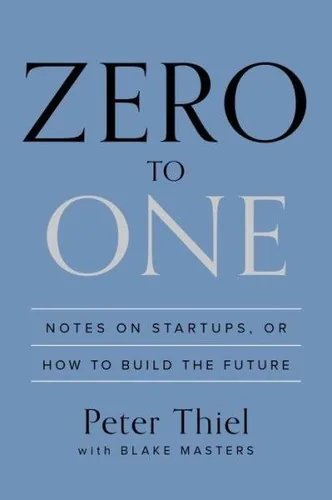
Zero to One
Notes on Startups, or How to Build the Future. A contrarian guide to creating genuinely new value rather than iterating on what already exists.
Why This Book Matters to Me
Zero to One fundamentally changed how I think about venture building. Thiel's central thesis — that the most valuable companies create something entirely new (going from 0 to 1) rather than competing in existing markets (going from 1 to n) — became the lens through which I evaluate every venture idea.
This book taught me to ask the contrarian question: "What important truth do very few people agree with you on?" For each of my six ventures, I started by identifying a truth that the market hadn't yet acted on.
Key Ideas Applied
Monopoly Thinking
Rather than competing in crowded markets, I look for underserved niches where I can build a defensible position. This shaped Vanguard-Community's focus on peer-support governance.
Definite Optimism
The belief that the future can be planned and built, not just discovered. This is the philosophy behind Vertex's structured four-theme approach to professional development.
Secrets
Every great venture is built on a secret — something you know that others don't. My secret: Morocco's graduates have knowledge but lack structured pathways to apply it.
Power Law
Most value comes from a few concentrated bets. This taught me to focus resources on the ventures with the highest conviction rather than spreading thin across many.
Favorite Quotes
On Competition"Competition is for losers. If you want to create and capture lasting value, don't build an undifferentiated commodity business."
On Contrarianism"The most contrarian thing of all is not to oppose the crowd but to think for yourself."
On Planning"A startup is the largest group of people you can convince of a plan to build a different future."
Connected To
Ventures InfluencedVertex, Vanguard-Community
Related ReadingThe Lean Startup — complementary validation methodology
Critical Engagement
Where I diverge
What the book argues
"Competition is for losers. The most valuable companies create monopolies by building something entirely new."
In emerging markets, collaboration often creates more value than monopoly.
Thiel's monopoly thesis works in mature Silicon Valley markets where winner-take-all dynamics dominate. But in Morocco's developing ecosystem, the market is too fragmented for monopolies to form naturally. Instead, collaborative networks — where multiple players serve different segments — create healthier, more resilient ecosystems. Competition here isn't destructive; it's a signal that demand exists and the market is worth serving.
Evidence from my experience
My six ventures operate in different sectors without competing with each other. The value comes from the network effect of shared learnings, not from any single venture dominating its market. Vanguard-Community thrives precisely because it collaborates with other student organizations rather than trying to monopolize peer support.
What the book argues
"The most successful companies are built by a singular visionary founder who sees a future others can't."
Distributed leadership is more resilient than founder-dependent models.
Thiel's founder-worship works for companies like PayPal and Palantir, but it creates single points of failure. In community-driven contexts, collective governance distributes risk, builds broader ownership, and creates organizations that survive beyond any individual. The question isn't "who has the best vision" but "who can build the most sustainable system."
Evidence from my experience
Vanguard-Community's collective decision-making model with 9 administrators means the community doesn't depend on me. If I stepped away tomorrow, the governance structure would continue functioning. TawjihYou, by contrast, was founder-dependent and had to be paused when my attention shifted.
Professional Relevance
How this shapes my professional practice
Strategic Thinking
Contrarian analysis helps me identify market opportunities others miss — a critical skill for strategy consulting, financial analysis, and venture evaluation.
Competitive Positioning
Understanding monopoly dynamics allows me to help organizations build defensible market positions rather than competing in commoditized spaces.
Long-Term Planning
Definite optimism as a framework means I approach projects with structured plans and measurable milestones — not vague hope.
Resource Allocation
Power law thinking means I focus effort on the highest-conviction opportunities — essential for portfolio management and project prioritization.