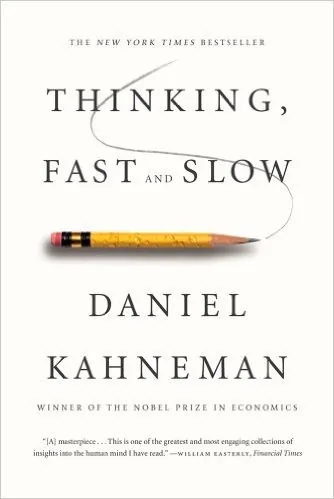
Thinking, Fast and Slow
A groundbreaking exploration of the two systems that drive the way we think — and how cognitive biases shape every decision we make.
Why This Book Matters to Me
[Add your personal reflection on how this book influenced your financial analysis and strategic thinking.]
Key Ideas Applied
System 1 vs System 2
[How you apply this distinction in financial modeling and decision-making]
Anchoring Bias
[How awareness of anchoring improved your negotiation and valuation skills]
Loss Aversion
[How this shaped your approach to venture risk assessment]
Framing Effects
[How you use framing in pitch decks and presentations]
Critical Engagement
Where I diverge
What the book argues
"System 1 (fast, intuitive thinking) is a source of systematic error. Most cognitive biases originate from this automatic mode."
In entrepreneurship and facilitation, System 1 pattern recognition is often more valuable than slow analysis — especially under time pressure.
Kahneman's research was conducted in controlled laboratory settings where participants solved abstract problems. In real-world facilitation and venture building, the "correct" answer often doesn't exist — you're navigating ambiguity, reading rooms, and making judgment calls. In these contexts, experienced intuition (System 1 trained by years of practice) consistently outperforms deliberate analysis. The key isn't to suppress System 1 but to train it through deliberate practice.
Evidence from my experience
During the Hate Speech Workshop, I noticed engagement dropping and doubled the session time on instinct — a System 1 judgment call. A System 2 analysis would have stuck to the planned 2 hours. The intuitive read of the room produced a better outcome than any pre-planned schedule could have.
What the book argues
"Debiasing is extremely difficult. Most attempts to reduce cognitive bias have limited effectiveness."
Structured group frameworks can meaningfully reduce bias — even if individual debiasing is hard.
Kahneman is right that individuals struggle to debias themselves. But he underestimates the power of structured group processes. When you design a workshop, meeting, or decision-making process that forces diverse perspectives, challenges assumptions, and requires evidence — the group collectively debiases in ways individuals cannot. The structure does the work that willpower can't.
Evidence from my experience
The Iceberg model used in the Hate Speech Workshop forced 50 participants to move past surface-level reactions (System 1) and systematically examine root causes. The framework didn't eliminate bias — it made bias visible and discussable, which is a more realistic and effective goal.
Professional Relevance
How this shapes my professional practice
Financial Analysis
Awareness of cognitive biases prevents systematic errors in valuation, forecasting, and risk assessment.
Decision Quality
Distinguishing System 1 from System 2 thinking helps me know when to trust instinct and when to run the numbers.
Negotiation
Understanding anchoring, framing, and loss aversion gives a structural advantage in negotiations and stakeholder management.
Audit Rigor
Recognizing overconfidence and confirmation bias makes me a more rigorous auditor who actively seeks disconfirming evidence.