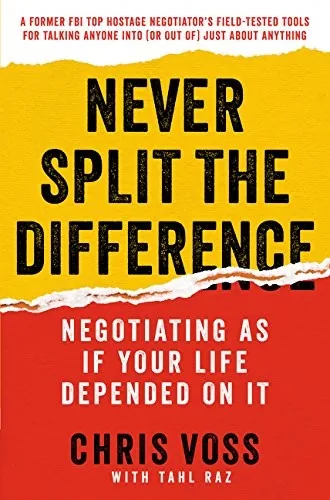
Never Split the Difference
Negotiating as if your life depended on it. A former FBI hostage negotiator's field method of tactical empathy, labeling, and calibrated questions.
Why This Book Matters to Me
Every venture I have built eventually sat across a table: a school deciding on a partnership, a supplier setting terms, an institution weighing an MOU. Voss taught me that those moments are not debates to win but discoveries to conduct — the counterpart's map of reality, not my arguments, decides the outcome.
As an auditor I negotiate constantly — the scope of a review, the wording of a finding, the timeline of a correction. Tactical empathy made those negotiations shorter and the relationships stronger.
Key Ideas Applied
Tactical Empathy
Understanding the counterpart's perspective is not agreement; it is reconnaissance. Partnership talks changed when I began by articulating their constraints better than they had.
Label the Negatives
Naming the other side's fears aloud — it seems you worry this adds work for your staff — defuses them faster than any reassurance I could invent.
Aim for "That's Right
Until the counterpart says that's right, they have not been heard and nothing moves. I summarize their position until it is exact before presenting mine.
Calibrated Questions
How am I supposed to do that? turns pressure into joint problem-solving and surfaces constraints without confrontation.
Favorite Quotes
On Negotiation"Negotiation is not an act of battle; it is a process of discovery."
On Empathy"Empathy is not sympathy; it is understanding the counterpart's world well enough to name it aloud."
On Agreement"You are not ready to propose terms until the other side can say that's right to your summary of theirs."
Connected To
Applied InTawjihYou — negotiating school and institutional partnerships
Related ReadingGive and Take — empathy in deals, generosity in networks
Critical Engagement
Where I diverge
What the book argues
"Voss's method was forged in hostage negotiation — a one-shot, adversarial, zero-sum crucible."
Most of my negotiations open long relationships; trust after the deal matters more than the deal itself.
Techniques optimized for extracting maximum value from a counterpart you will never meet again can read as manipulation to a partner you will work with for years. In repeated games, transparency and fairness outperform tactical advantage, because reputation is the asset.
Evidence from my experience
My most durable partnerships were built on openly shared terms; the relationships where I pushed hardest for advantage are precisely the ones that did not survive.
What the book argues
"The book centers on letting the counterpart feel in control while you steer."
In community and educational work, people should actually be in control; steering without ownership undermines the mission.
The illusion of control is fine when the goal is a price. It is wrong when the goal is empowerment: a community that discovers its own decision is owning nothing if I planted it quietly. There I replace calibrated steering with genuinely open questions and accept slower, real consensus.
Evidence from my experience
Vanguard-Community's strongest initiatives were the ones members conceived themselves; the ones I steered into existence died when I stepped back.
Professional Relevance
How this shapes my professional practice
Partnership Development
Discovery-first negotiation opens institutional doors for ventures and programs.
Audit Findings
Framing findings as shared problems increases the rate at which they are corrected.
Procurement & Terms
Labeling and calibrated questions surface real constraints and better pricing.
Conflict De-escalation
Naming fears aloud is directly applicable to tense stakeholder meetings.