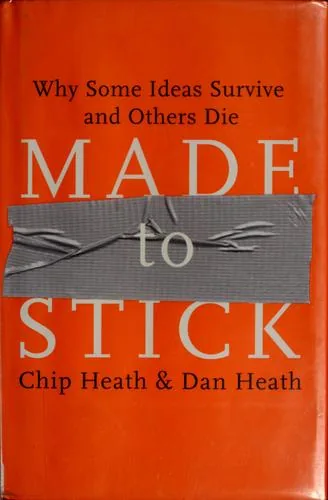
Made to Stick
Why some ideas survive and others die. Simple, unexpected, concrete, credible, emotional, story — the anatomy of ideas that are understood and remembered.
Why This Book Matters to Me
One hundred sixty hours in front of students taught me that knowing a subject and making it stick are two different professions. The Heath brothers' SUCCESs framework — simple, unexpected, concrete, credible, emotional, story — became the design checklist behind every lesson, workshop and pitch I deliver.
The book's villain, the Curse of Knowledge, explained my earliest teaching failures: once you know finance, you can no longer hear the jargon as a student does. Curing that curse rebuilt how I explain control systems, financial modeling, and even community strategy.
Key Ideas Applied
Find the Core
One lesson, one core message, stated in a single sentence; I cut content until the priority is undeniable — the difference between covering and teaching.
Be Concrete
Abstract principles die; concrete cases live. My audit teaching runs on real numbers from real statements, not definitions.
Defeat the Curse of Knowledge
I test every explanation on someone outside the field before I teach it; if they cannot retell it, the idea is not yet simple — it is only familiar to me.
Tell Stories That Simulate
Stories let learners rehearse judgment. Scenario narratives — a company, a red flag, a decision — are the backbone of my workshops, from finance to hate-speech prevention.
Favorite Quotes
On the Curse"The Curse of Knowledge: once we know something, we find it almost impossible to imagine what it was like not to know it."
On Simplicity"Simple is not dumbing down; it is finding the core and leading with it."
On Stickiness"Sticky ideas are understood, remembered, and change behavior — simplicity, surprise, concreteness, credibility, emotion, story."
Connected To
Applied InHate-Speech Counter-Initiative — emotional, story-driven workshops for 50 participants
Trainer TrainingTraining of Trainers — Critical Thinking — where pedagogy meets stickiness
Critical Engagement
Where I diverge
What the book argues
"The SUCCESs framework optimizes for memorability and spread — for ideas that travel."
In finance and audit, spread is not the goal; precision is. Some truths that stick are truths distorted.
A simplified, emotional message travels beautifully and can also mislead: a sticky rule of thumb about ratios or risk can harden into false doctrine. In technical teaching I therefore pair every sticky headline with its boundary conditions — when the rule breaks — so stickiness carries the idea without smuggling in overconfidence.
Evidence from my experience
Students remembered my profit-is-an-opinion, cash-is-a-fact line perfectly; the ones I also drilled on its exceptions produced the better analysis.
What the book argues
"The book treats the audience's attention as the scarce resource to be captured."
In classrooms and communities, trust is the scarce resource; surprise used for its own sake spends it.
Unexpected openings earn attention, but in relational settings repeated theatrics read as performance and erode seriousness. I reserve surprise for genuinely important moments, so that when I break pattern, it means something.
Evidence from my experience
My most effective sessions open plainly and earn attention through respect; the over-produced openings I tried early won laughs and lost retention.
Professional Relevance
How this shapes my professional practice
Teaching & Training
SUCCESs is the design checklist behind 160+ hours of instruction and trainer sessions.
Workshop Facilitation
Concrete, story-based design is why attitude-change workshops outperformed lecture formats.
Pitch & Communication
Core-first, concrete messaging structures my pitch decks and venture narratives.
Reporting
Findings written simply and concretely get acted on; the Curse of Knowledge explains why most reports do not.