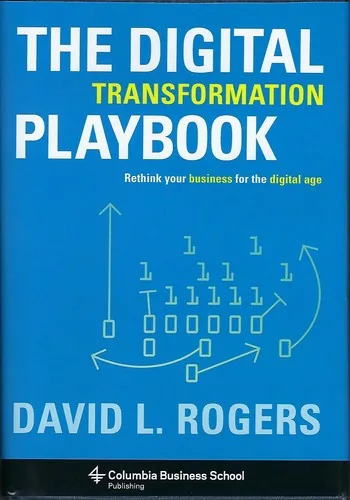
The Digital Transformation Playbook book cover
AuthorDavid L. Rogers
Published2016
CategoryDigital Transformation / Strategy

The Digital Transformation Playbook

Rethink Your Business for the Digital Age. A strategic framework for transforming how an organization creates value — drawn from Columbia Business School research.

Why This Book Matters to Me

Rogers reframed digital transformation for me as a strategic question, not a technology project. His argument — that digital changes the rules of value creation across five domains (customers, competition, data, innovation, value) — is the intellectual backbone of my thesis on the impact of digital transformation on management control systems.

Where most treatments stop at 'adopt the tools,' Rogers insists that control and measurement systems must evolve with the strategy. That insight directly shaped my thesis question: how do management control systems adapt when the business itself becomes digital?

Key Ideas Applied

Customers as a Network
Value is co-created with customers, not pushed at them. This shaped TawjihYou's orientation model, where students both receive and contribute guidance.
Data as a Strategic Asset
Treating data as an asset to be leveraged, not a by-product to be stored, is why I built metrics and reporting into every venture from day one.
Innovation Through Experimentation
Rogers' model of low-cost, high-learning experiments is the method behind my venture validation — testing assumptions before committing resources.
Redefining Competition
Digital blurs industry boundaries, turning competitors into partners. My six ventures collaborate across sectors rather than defending turf.

Favorite Quotes

On Strategy"Digital transformation is not about the technology; it is about the strategy and the new ways of thinking that technology makes possible."
On Value"A firm must continually rethink the value it offers, because digital gives customers more power and more choices than ever before."
On Change"The organizations that thrive are not the ones that resist change but the ones that build the capability to change continuously."

Connected To

Related ReadingChange by Design — the design-thinking complement to digital strategy
Critical Engagement
Where I diverge
What the book argues "Rogers writes from the vantage of large, data-mature firms in advanced markets."
In emerging markets, transformation is constrained by data and infrastructure maturity, so it must be sequenced, not simultaneous.
Rogers' five-domain model assumes organizations already generate rich digital data. Many Moroccan SMEs do not — their records are paper-based and fragmented. For them, the first step of 'digital transformation' is digitizing the basics, not deploying AI. A control system can only become 'digital' once the underlying data exists.
Evidence from my experience My thesis fieldwork and my consulting with early-stage ventures showed that firms that tried to leap straight to advanced analytics failed, while those that sequenced — digitize records, then reporting, then analysis — built durable control systems.
What the book argues "The book treats data as an asset the firm owns and exploits."
In low-trust environments, data sharing must be reciprocal and transparent to work at all.
Rogers' asset framing works where customers trust firms with their data. In markets with low institutional trust, customers withhold data unless they get clear, immediate value back. The playbook must therefore begin with exchange, not extraction.
Evidence from my experience TawjihYou only gathered student data after giving concrete orientation value first; engagement — and data quality — rose together.
Professional Relevance
How this shapes my professional practice
Digital Strategy Advisory
The five-domain model gives me a structured lens to assess how digital changes a firm's value proposition — directly applicable to management consulting and digital-transformation roles.
Control-System Design
Linking strategy to measurement systems is the core of my thesis and of modern management-control practice.
Data-Informed Analysis
Treating data as a strategic asset underpins my financial modelling and reporting work.
Change Leadership
Sequencing transformation is a change-management skill valued in audit and advisory engagements.