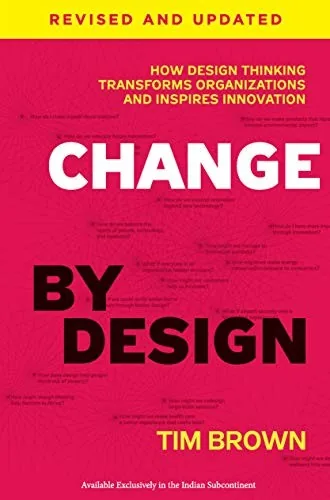
Change by Design
How Design Thinking Transforms Organizations and Inspires Innovation. The methodology I apply across workshops and venture validation.
Why This Book Matters to Me
[Add your personal reflection on how Design Thinking became your core methodology.]
Key Ideas Applied
Empathize
[How user research shaped your workshop and venture design]
Ideate
[How brainstorming frameworks improved your team outputs]
Prototype
[How rapid prototyping reduced risk in your ventures]
Test
[How user testing validated the Hate Speech Workshop design]
Critical Engagement
Where I diverge
What the book argues
"Design Thinking is universally applicable — any organization, any problem, any context can benefit from the methodology."
In highly regulated environments like finance and audit, Design Thinking's iterative approach conflicts with compliance requirements — it needs adaptation.
Brown presents Design Thinking as a universal methodology, but his examples are overwhelmingly from product design, services, and social innovation. In finance and audit — where I've spent 5 years studying — "move fast and iterate" directly conflicts with regulatory requirements for documented, approved processes. You can't prototype a financial control system and "learn from failure" when a failed control means a compliance breach. Design Thinking works in these contexts only when the prototyping happens at the design level, not the implementation level.
Evidence from my experience
My thesis on digital transformation in management control systems showed that organizations adopting iterative design approaches in their control systems had to create parallel tracks — one for innovation prototyping and one for compliance-approved implementation. The methodology worked, but only because it was adapted to the regulatory context.
What the book argues
"Prototype everything. The best way to test an idea is to build a quick, rough version and put it in front of users."
Some decisions require thorough analysis before any prototyping — not everything benefits from rapid iteration.
Prototyping is powerful for products, services, and experiences where the cost of a bad prototype is low. But for financial commitments, legal structures, governance models, and partnership agreements, a "quick rough version" can create irreversible obligations. These decisions need the opposite of rapid prototyping — they need thorough analysis, scenario planning, and risk assessment before any commitment is made. Knowing when NOT to prototype is as important as knowing when to prototype.
Evidence from my experience
Vanguard-Community's governance structure was deliberately designed through weeks of analysis before implementation — not prototyped and iterated. A "rough" governance model would have created power imbalances and trust issues that would have been nearly impossible to fix later. Some foundations need to be right the first time.
Professional Relevance
How this shapes my professional practice
Problem Solving
Design Thinking provides a structured methodology for solving complex, ambiguous problems — exactly what consulting and strategy roles require.
User-Centric Thinking
Empathy-driven research translates to better client understanding and market analysis in any role.
Rapid Prototyping
Testing ideas quickly before full commitment reduces risk in project planning and strategic initiatives.
Facilitation
Leading cross-functional teams through structured ideation sessions — a high-value skill for any collaborative environment.