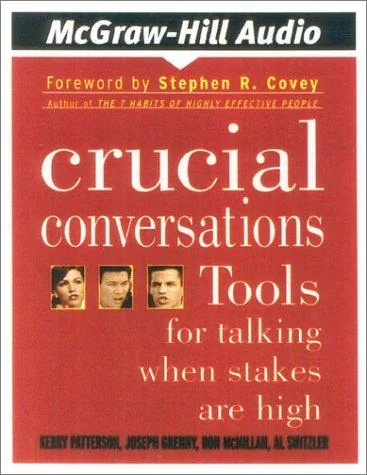
Crucial Conversations
Tools for talking when stakes are high, opinions vary, and emotions run strong. The method for keeping dialogue alive exactly when it matters most.
Why This Book Matters to Me
The hardest moments of my young career have all been conversations: delivering an audit finding a manager did not want to hear, telling a volunteer team a project was ending, aligning 28 administrators with conflicting views. Crucial Conversations gave me a method for precisely those moments — high stakes, strong emotions, opposing opinions.
Its deepest lesson is that content and safety are separate channels: people defend themselves, not their ideas. Once I learned to build safety first, the hardest subjects became discussable.
Key Ideas Applied
Start with Heart
Before a difficult conversation I ask what I actually want — for the relationship and for the outcome — which keeps me from drifting into winning or punishing.
Make It Safe
Candor requires safety. Naming mutual purpose and respect mid-conversation has repeatedly brought derailed discussions back into dialogue.
Master My Stories
Separating observable facts from the story I tell about them is the conversational twin of audit discipline: evidence first, interpretation second.
Move to Action
Every crucial conversation closes with decisions, owners and follow-up dates — the quiet governance system behind coordinating large volunteer teams.
Favorite Quotes
On Pressure"When stakes are high, opinions vary, and emotions run strong, we are often on our worst behavior."
On Safety"People do not defend ideas; they defend themselves. Make it safe, and almost anything becomes discussable."
On Stories"Others do not make us feel what we feel; our emotions are the product of the stories we tell ourselves."
Connected To
Applied InCommunity Building — mediating conflict and aligning administrators
Paired WithHow to Win Friends — climate first, then content
Critical Engagement
Where I diverge
What the book argues
"The model assumes that once safety is established, participants speak as relative equals."
In hierarchical institutions, power distance does not disappear because the room feels safe — juniors self-censor anyway.
The book's dialogue ideal presumes a culture where speaking up to superiors is legitimate. In Moroccan institutional settings, a junior naming a problem to a senior in open session can cost the senior face. Safety must therefore be engineered structurally — private one-to-ones, written channels, respected intermediaries — not only emotionally.
Evidence from my experience
Sensitive feedback from my teams only surfaced after I introduced private written channels and third-party intermediaries; the open-room format that works on paper produced polite silence.
What the book argues
"The book treats every crucial conversation as one to be fully dialogued to consensus."
In fast-moving ventures, some conversations need a decision now and repair later; complete process is a luxury of stable organizations.
Full dialogue takes time and emotional energy that early-stage teams do not have. I have learned to distinguish conversations that need consensus from conversations that need clarity: decide, communicate the why, and repair the relationship afterwards.
Evidence from my experience
When TawjihYou had to pivot quickly, I decided transparently and repaired one-to-one afterwards — Drucker's decisiveness paired with Crucial Conversations' repair work.
Professional Relevance
How this shapes my professional practice
Audit & Assurance
Delivering findings so they are heard, not resisted, is a core audit skill — safety plus evidence.
Management
Aligning administrators with conflicting interests is exactly crucial-conversation territory.
Mediation & Governance
Structured dialogue turns community disputes into decisions with owners and dates.
Teaching Feedback
Hard feedback to students lands when the relationship is safe first.