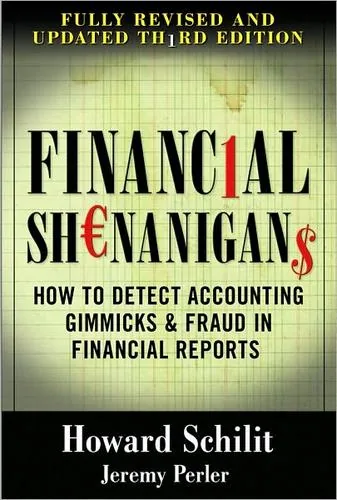
Financial Shenanigans
How to Detect Accounting Gimmicks & Fraud in Financial Reports. The classic field guide to spotting earnings manipulation before it surfaces.
Why This Book Matters to Me
Schilit trained my eye to read financial statements the way a forensic auditor does — not for what they say, but for what they hide. The seven shenanigans gave me a disciplined checklist for interrogating revenue, expenses, and cash flow.
As a finance graduate specializing in control and audit, this book is the bridge between textbook accounting and the reality of managed numbers. It sharpened the professional skepticism my thesis jury commended.
Key Ideas Applied
The Seven Shenanigans
Recording revenue too early, bogus revenue, one-time gains, shifting expenses later, hiding liabilities, shifting income later, and pulling expenses forward — a complete taxonomy of manipulation I apply in analysis.
Cash Flow Over Accruals
Sustained divergence between operating cash flow and reported profit is the single most reliable red flag; I always reconcile the two before trusting earnings.
Red-Flag Indicators
Sudden changes in policy, related-party transactions, and auditor turnover are signals to dig deeper, not footnotes to skip.
The Fraud Mindset
Understanding the incentives behind manipulation — pressure, opportunity, rationalization — makes me a more effective auditor and analyst.
Favorite Quotes
On Skepticism"The goal is not to assume fraud, but to refuse to assume honesty without evidence."
On Cash"Profit is an opinion; cash is a fact. When the two disagree long enough, the opinion eventually loses."
On Detection"The earlier you recognize a shenanigan, the better positioned you are — the tricks repeat because they work until they are seen."
Connected To
Informs My Audit PracticeMaster's in Finance, Control & Audit
Applied InFinancial Modeling — building models that surface, not hide, economic reality
Critical Engagement
Where I diverge
What the book argues
"Schilit catalogues shenanigans in large, publicly listed US companies."
In private and emerging-market firms, manipulation is simpler — and controls weaker — so the detection focus shifts to cash and related parties.
The seven shenanigans assume sophisticated accrual accounting and market pressure to meet forecasts. Many Moroccan private firms have no such pressure; their risks are unrecorded liabilities and informal cash. The forensic lens must therefore start from the bank statement and the related-party ledger, not the revenue footnote.
Evidence from my experience
In my apprenticeships at FIDU Nord West and Sagesse Conseil, the anomalies that mattered were missing liabilities and commingled owner accounts — exactly the simpler end of Schilit's spectrum.
What the book argues
"The book frames detection as the analyst's job after the fact."
Strong internal controls should prevent most shenanigans, making detection a backstop rather than the front line.
Schilit teaches reading manipulated statements; my training in management control emphasizes designing systems where manipulation is hard in the first place. Prevention and detection are complementary, and I weight prevention higher for the firms I advise.
Evidence from my experience
My thesis on management control systems argues that well-designed controls reduce both the opportunity and the need for manipulation — the preventive half of Schilit's story.
Professional Relevance
How this shapes my professional practice
Audit & Assurance
A structured taxonomy of manipulation directly strengthens audit planning, risk assessment and substantive testing.
Financial Analysis
Reconciling cash to accruals is core to credible equity and credit analysis.
Forensic Accounting
The fraud-triangle mindset is the foundation of forensic and investigative work.
Professional Skepticism
The commended analytical rigor in my thesis reflects exactly this discipline.